When the distance of the sensing object changes, the position where the light is received on the receiver element changes. This change is converted into a displacement reading.
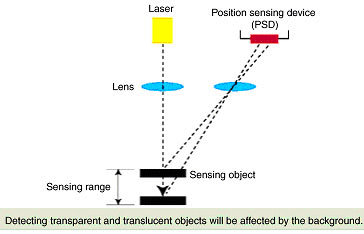
The laser light is emitted from the emitter lens towards the sensing object. The light that is reflected off the object is collected by the receiver and an image is formed on the PSD. If the distance of the sensing object differs, the image formed on the PSD varies. The two PSD outputs will change.
The ratio of these two outputs is found and then converted to a distance. Compared to a CCD, a PSD is smaller, faster and can be produced at lower cost.
Smart Sensors Using Diffuse Reflection
ZX-LD40(L), ZX-LD100(L), ZX-LD300(L)
The difference between the diffuse reflection method and the regular reflection method is described below.
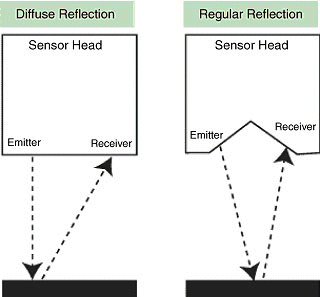
The diffuse reflection method collects the diffuse light reflected from the sensing object.
The diffuse light method gives stable measurements. It can be used even when the reflection angle variation is large. If the surface is shiny, the accuracy becomes low and it may not be able to make measurements. The regular reflection method detects the object using regular reflection.
Accurate measurements can be made for shiny surfaces but it doesn't have a large tolerance for angle variance.
The laser light is emitted from the emitter lens towards the sensing object. The light that is reflected off the object is collected by the receiver and an image is formed on the PSD. If the distance of the sensing object differs, the image formed on the PSD varies. The two PSD outputs will change.
The ratio of these two outputs is found and then converted to a distance. Compared to a CCD, a PSD is smaller, faster and can be produced at lower cost.
Smart Sensors Using Diffuse Reflection
ZX-LD40(L), ZX-LD100(L), ZX-LD300(L)
The difference between the diffuse reflection method and the regular reflection method is described below.
The diffuse reflection method collects the diffuse light reflected from the sensing object.
The diffuse light method gives stable measurements. It can be used even when the reflection angle variation is large. If the surface is shiny, the accuracy becomes low and it may not be able to make measurements. The regular reflection method detects the object using regular reflection.
Accurate measurements can be made for shiny surfaces but it doesn't have a large tolerance for angle variance.
Was this article helpful?
That’s Great!
Thank you for your feedback
Sorry! We couldn't be helpful
Thank you for your feedback
Feedback sent
We appreciate your effort and will try to fix the article